
- Of the countries we cover, only Malaysia is slated to benefit.
- For the rest, upside to inflation and downside to growth is gathering swiftly.
- China has considerable stockpile.
- India and Singapore have been diversifying their energy mix.
- Japan, South Korea, Taiwan, and Thailand have substantial worries.

Related Insights
Click here to read the full report.
Commentary: Asia’s vulnerability to Iran crisis
The ongoing conflict in Iran, with intense strikes by Israel-US and sporadic reprisals from Iran, is making the markets anxious. Although the conflict is characterised by highly asymmetric balance of power, and the intensity of Iran’s missile and drone responses has already diminished, fears of energy shipments through the Straits of Hormuz getting disrupted is rising. USD100/barrel oil, unthinkable two weeks ago, is now very much on the cards.
The region’s criticality to global energy supply is well understood, but for several Asian economies, the risk extends to well beyond energy. For India, nearly 13% of total exports go to the Middle Eastern countries that are adjacent to the conflict zone. Nearly two-thirds of those exporters are bound for the UAE. Potential disruption to shipping routes there would pose a major downside to its exporters.
Beyond India, for the Asian countries we track, exports to the Middle East make up for less than 5% of their total exports. A demand shock there would not be trivial, but not sufficient to put the exports sector under distress, in our view. It’s a whole different ball game when it comes to importing energy.
India, Japan, South Korea, and Taiwan are particularly exposed to energy imports from the conflict affected area. Singapore and Thailand are not far behind. Looking for alternative sources of supply or routes might be feasible, but at greater cost and considerable delays.
There are three channels of concern. First, economic activity and hiring could be curtailed in response to higher energy prices and reduced corporate margin. Second, inflation could shoot up in areas beyond energy prices, as producers grapple with higher cost of production. Third, as import bills rise due to higher prices, the trade balance would worsen, affecting the balance of payments, with adverse implications for the currency. Below we present an analysis, done by our economists, on country-by-county impact if oil remains at around USD100/barrel for the rest of the year. 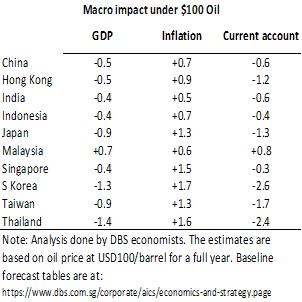
Click here to read the full report.


Topic
GENERAL DISCLOSURE/ DISCLAIMER (For Macroeconomics, Currencies, Interest Rates & Digital Assets)
The information herein is published by DBS Bank Ltd and/or DBS Bank (Hong Kong) Limited (each and/or collectively, the “Company”). It is based on information obtained from sources believed to be reliable, but the Company does not make any representation or warranty, express or implied, as to its accuracy, completeness, timeliness or correctness for any particular purpose. Opinions expressed are subject to change without notice. This research is prepared for general circulation. Any recommendation contained herein does not have regard to the specific investment objectives, financial situation and the particular needs of any specific addressee. The information herein is published for the information of addressees only and is not to be taken in substitution for the exercise of judgement by addressees, who should obtain separate legal or financial advice. The Company, or any of its related companies or any individuals connected with the group accepts no liability for any direct, special, indirect, consequential, incidental damages or any other loss or damages of any kind arising from any use of the information herein (including any error, omission or misstatement herein, negligent or otherwise) or further communication thereof, even if the Company or any other person has been advised of the possibility thereof. The information herein is not to be construed as an offer or a solicitation of an offer to buy or sell any securities, futures, options or other financial instruments or to provide any investment advice or services. The Company and its associates, their directors, officers and/or employees may have positions or other interests in, and may effect transactions in securities mentioned herein and may also perform or seek to perform broking, investment banking and other banking or financial services for these companies. The information herein is not directed to, or intended for distribution to or use by, any person or entity that is a citizen or resident of or located in any locality, state, country, or other jurisdiction (including but not limited to citizens or residents of the United States of America) where such distribution, publication, availability or use would be contrary to law or regulation. The information is not an offer to sell or the solicitation of an offer to buy any security in any jurisdiction (including but not limited to the United States of America) where such an offer or solicitation would be contrary to law or regulation.
[#for Distribution in Singapore] This report is distributed in Singapore by DBS Bank Ltd (Company Regn. No. 196800306E) which is Exempt Financial Advisers as defined in the Financial Advisers Act and regulated by the Monetary Authority of Singapore. DBS Bank Ltd may distribute reports produced by its respective foreign entities, affiliates or other foreign research houses pursuant to an arrangement under Regulation 32C of the Financial Advisers Regulations. Where the report is distributed in Singapore to a person who is not an Accredited Investor, Expert Investor or an Institutional Investor, DBS Bank Ltd accepts legal responsibility for the contents of the report to such persons only to the extent required by law. Singapore recipients should contact DBS Bank Ltd at 65-6878-8888 for matters arising from, or in connection with the report.
DBS Bank Ltd., 12 Marina Boulevard, Marina Bay Financial Centre Tower 3, Singapore 018982. Tel: 65-6878-8888. Company Registration No. 196800306E.
DBS Bank Ltd., Hong Kong Branch, a company incorporated in Singapore with limited liability. 18th Floor, The Center, 99 Queen’s Road Central, Central, Hong Kong SAR.
DBS Bank (Hong Kong) Limited, a company incorporated in Hong Kong with limited liability. 11th Floor, The Center, 99 Queen’s Road Central, Central, Hong Kong SAR.
Virtual currencies are highly speculative digital "virtual commodities", and are not currencies. It is not a financial product approved by the Taiwan Financial Supervisory Commission, and the safeguards of the existing investor protection regime does not apply. The prices of virtual currencies may fluctuate greatly, and the investment risk is high. Before engaging in such transactions, the investor should carefully assess the risks, and seek its own independent advice.