
- North American leagues are dominating global valuations
- Accelerated growth in the sports industry can be attributed to the streaming revolution
- Investing in sports franchises is fueled by soaring valuations and unique diversification benefits
- Strategic involvement of private equity in sports and entertainment adds investment value
- Sports franchises benefit from streams of income generated both at the league and individual levels

Related Insights
- Global Surgical Robot Sector: Inflection Point08 May 2026
- Singapore Equities: Defensive Leader07 May 2026
- Private Equity: Dispersion Calls for Selectivity04 May 2026

- The streaming revolution. Live sports has become the most coveted content in the streaming wars, attracting Big Tech giants like Amazon, Apple, Google, Netflix, and Meta to aggressively acquire live sports streaming rights. According to estimates by Ampere analysis, Big Tech’s spending on sports media rights has grown from USD2.8bn in 2020 to USD14.2bn in 2026, marking a fivefold increase. The strategic logic is straightforward, as live sports drives subscriber acquisition, reduces churn, and commands premium advertising rates that on-demand content simply cannot match. According to estimates by SportBusiness, the Global Sports Media Rights market is expected to reach USD66.3bn by 2028, growing at a 3.1% CAGR from 2021 to 2028. For franchise owners, the entry of deep-pocketed streaming platforms into rights negotiations has structurally reset the floor for broadcasting valuations, and with several major rights packages, including the NBA, NFL international, and Champions League, still to be renegotiated in the next cycle. The upside is far from fully priced in.
- Breaking barriers with women’s sports. Historically, women’s sports have been overshadowed by men’s, but a re-rating of its commercial value driven by surging viewership, deepening fan engagement, and a wave of institutional capital is beginning to arrive. The WNBA’s 2025 regular season was its most watched in 25 years and a landmark USD2.2bn media rights deal (c.200% above its prior agreement) confirms broadcasters are starting to price in real audience value. The FIFA Women’s World Cup 2023 generated USD570mn in broadcast revenue, surpassing projections by c.35%. Investment has followed: WNBA franchise values rose 180% in 2025, more than double any other North American league, with expansion fees now exceeding USD250mn vs USD50mn just four years ago. For investors who witnessed the explosive growth of NBA or NFL, the setup in women’s sports today will look familiar, and the runway is considerably longer.
- eSports, no longer a sideshow. With more than 3.3bn gamers worldwide, gaming is one of the most popular forms of entertainment, and sports titles consistently rank among the most played: EA Sports FC alone has sold over 325mn copies since its 1993 debut, while NBA 2K and Madden NFL each command tens of thousands of daily active players. These are not passive consumers, they are among the most engaged sports fans in the world, spending more time with a sports franchise through a controller than a television. The esports dimension adds another layer: competitive gaming tournaments for FIFA, NBA 2K, Madden, and Formula 1 now draw up to millions of live viewers, with prize pools and sponsorship structures that increasingly mirror traditional leagues. For franchise owners, sports gaming represents a permanent, year-round brand activation, one that is especially powerful in the off-season when traditional engagement drops. Global eSports and sports gaming revenue is projected to reach USD55.4bn by 2035, growing at a 21.2% CAGR from 2026 to 2035, according to Precedence Research. The bottom line is every player of a sports video game is a potential season ticket holder, and franchises that invest in this ecosystem early are building fanbases that will monetise for decades.
- Scarcity premium. Sports franchises exist in tightly limited supply and broadly fall into two categories. Regulated scarcity dominates North American sports, where leagues deliberately cap the number of franchises and impose strict requirements for establishing new teams, keeping supply constrained and supporting strong long-term valuation growth. As a result, there are only 154 sports franchises across the five major leagues. Meritocratic scarcity defines European football, where league positions are earned through promotion and defended against relegation. This scarcity is clear at the top tier, where the English Premier league is limited to only 20 teams. Whether imposed by leagues or earned on the pitch, limited franchise supply concentrates broadcasting and sponsorship revenues among few owners, delivering stable cash flows.
- Diversification benefits of sports investment. Between 2002 to 2023, the average franchise values of major US sports leagues exhibited low or even negative correlation compared to traditional assets like equities and bonds. This low or negative correlation is primarily due to the fact that a significant portion of sports revenue is derived from broadcasting rights and sponsorship deals which are typically long-term, providing these sports franchises with stable, recurring income. Additionally, the limited number of available sports franchises create a scarcity factor that helps keep valuations buoyed, making sports franchises less susceptible to gyrations in the market.
- Private equity’s long-term focus drives operational efficiency. Sports leagues were initially reluctant to get involved with PE over concerns that the high leverage and “short-termism” nature of PE funds would be detrimental to their financial stability and long-term success. However, by the 2000s, PE started to adopt a long-term investing approach. They have since demonstrated their ability to enhance value by driving revenue growth, improving operation efficiency and leveraging connections to secure sponsorship deals, prompting sport leagues and franchises to reconsider their involvement. Recognising the benefits of PE, major leagues in North America have amended regulations to allow PE to hold equity stakes in sports franchises.
Central Revenue
The central revenue forms the main bulk of each team’s total revenue. It is generated at the league level and distributed evenly among individual teams. The primary components of central revenue are:
- National Broadcasting Rights: Constituting a significant portion of central revenue, these are broadcasting rights negotiated at a league level with major networks and streaming platforms. A prime example of this is the NFL’s 2021 agreement, which was valued at an astounding USD111bn over 11 years, to be divided equally among the league’s 32 teams.
- League-Wide Sponsorships: These are partnerships secured at the league level. The size of the global sports sponsorship market was valued at USD105.5bn in 2023 and is expected to grow at a CAGR of 7.6% to reach USD189.5bn by 2030.
- Tickets and Luxury Suites: While ticket sales are often associated with individual teams, a portion of this revenue is pooled and distributed centrally under the ticket revenue sharing system. In the NFL, 40% of all ticket sales enter a pool to be redistributed among all teams, while the home team keeps 60%. In 2023, the NFL generated USD3bn from tickets and luxury suites. The robust demand is evident in pricing trends, with 13 NFL teams implementing double digit price increases for tickets in 2023, with an average increase of 8.6% across the NFL.
Local revenue includes ticket sales (excluding shared revenue from the league level), premium seating, team-specific sponsorships, local media rights, concessions, parking, merchandising, and other income. These revenues are made and retained by the individual teams.
- Ticket Sales and Premium Seating: Teams generate significant income from the sale of general admission tickets, premium seating, and luxury suites.
- Team Sponsorships: Individual teams negotiate and secure their own sponsorships deals with brands. This could include naming rights for the stadium, advertising, and partnerships.
- Local Media Rights: Teams negotiate local broadcasting rights with local television networks and radio networks. This could include rights to broadcast preseason games and content not covered by the league-level national deals.
- Concessions, Parking, Merchandise: Gameday revenue such as the sale of food and beverages, parking.
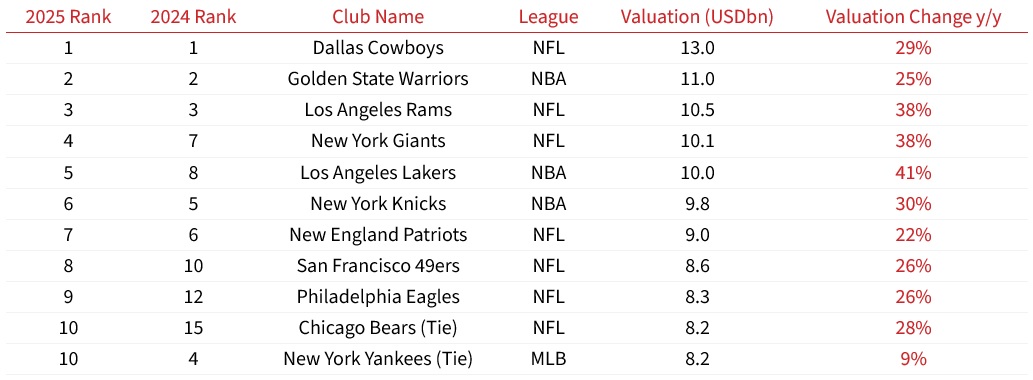
Source: Forbes, DBS
Download the PDF to read the full report.
Topic
This information is for your private use only and may not be passed on, reposted or reproduced. The contents of this information are strictly confidential and are not transferrable, assignable or meant for reissuance to any third party, whether in whole or in part.
This information does not constitute or form part of any offer, recommendation, invitation or solicitation to subscribe to or to enter into any transaction. It does not have regard to your specific investment objectives, financial situation or particular needs. It is not intended to provide, and should not be relied upon for accounting, legal or tax advice.
All investments involve risks and you can lose part or all of your investment. You should carefully read the product offering documentation and any product terms before making any investment. If you have any doubt, please seek independent professional advice or otherwise you should carefully consider whether any product mentioned in this publication is suitable for you. Any investment product(s) mentioned herein is/are not the only product(s) that is/are aligned with views stated herein and may not be the most preferred or suitable product for you. There are other investment product(s) available in the market which may better suit your investment profile, objectives and financial situation.
DBS or persons/entities connected to the DBS Group may, or in the future, have interests in and may affect transactions in the underlying product(s) mentioned. Companies connected to DBS may have arrangements with the issuer(s) of the underlying product(s) to market or sell its product(s). Where any company within the DBS Group is the product provider, such company may be receiving fees from the investors. In addition, companies within the DBS Group may also perform broking, investment banking and other banking or financial services to the issuers or the related companies.
DBS Group does not make any warranty as to this information’s accuracy, timeliness, adequacy or completeness for any particular purpose, and thus accepts no responsibility for any losses whatsoever arising from or in connection with the use or reliance on this information and any related documents. Past performance is no guarantee of future results, and future results may not meet your expectations due to a variety of economic, market and other factors. This information is subject to change without notice. All figures and amounts stated are for illustration purposes only and shall not bind DBS Group.
If this information has been distributed by electronic transmission, such as e-mail, then such transmission cannot be guaranteed to be secure or error-free.
This information is not directed to, or intended for distribution to anyone who is a citizen or resident of or located in any jurisdiction where such distribution, publication, availability or use would be contrary to law or regulation.
This publication has not been reviewed or authorised by any regulatory authority in Singapore, Hong Kong, Dubai International Financial Centre, Thailand, United Kingdom or elsewhere. There is no planned schedule or frequency for updating the information discussed in this publication.
If any specific product(s) are mentioned herein, such investment product(s) is/are are not the only product(s) that is/are aligned with the views stated in the research report(s) and may not be the most preferred or suitable product for you. There are other investment product(s) available in the market which may better suit your investment profile, objectives and financial situation.
The English version of all documents shall apply and prevail over that in other languages that may be provided for your reference.
Dubai International Financial Centre
This communication is provided to you as a Professional Client or Market Counterparty as defined in the DFSA Rulebook Conduct of Business Module (the "COB Module"), and should not be relied upon or acted on by any person which does not meet the criteria to be classified as a Professional Client or Market Counterparty under the DFSA rules.
This communication is from the branch of DBS Bank Ltd operating in the Dubai International Financial Centre (the "DIFC") under the trading name "DBS Bank Ltd. (DIFC Branch)" ("DBS DIFC"), registered with the DIFC Registrar of Companies under number 156 and having its registered office at units 608 - 610, 6th Floor, Gate Precinct Building 5, PO Box 506538, DIFC, Dubai, United Arab Emirates.
DBS DIFC is regulated by the Dubai Financial Services Authority (the "DFSA") with a DFSA reference number F000164.
Where this communication contains a research report, this research report is prepared by the entity referred to therein, which may be DBS Bank Ltd or a third party, and is provided to you by DBS DIFC. The research report has not been reviewed or authorised by the DFSA. Such research report is distributed on the express understanding that, whilst the information contained within is believed to be reliable, the information has not been independently verified by DBS DIFC.
Unless otherwise indicated, this communication does not constitute an "Offer of Securities to the Public" as defined under Article 12 of the Markets Law (DIFC Law No.1 of 2012) or an "Offer of a Unit of a Fund" as defined under Article 19(2) of the Collective Investment Law (DIFC Law No.2 of 2010).
The DFSA has no responsibility for reviewing or verifying this communication or any associated documents in connection with this investment and it is not subject to any form of regulation or approval by the DFSA. Accordingly, the DFSA has not approved this communication or any other associated documents in connection with this investment nor taken any steps to verify the information set out in this communication or any associated documents, and has no responsibility for them. The DFSA has not assessed the suitability of any investments to which the communication relates and, in respect of any Islamic investments (or other investments identified to be Shari'a compliant), neither we nor the DFSA has determined whether they are Shari'a compliant in any way.
Any investments which this communication relates to may be illiquid and/or subject to restrictions on their resale. Prospective purchasers should conduct their own due diligence on any investments. If you do not understand the contents of this document you should consult an authorised financial adviser.
Hong Kong
This publication is distributed by DBS Bank (Hong Kong) Limited (CE Number: AAL664) (“DBSHK”) which is regulated by the Hong Kong Monetary Authority (the "HKMA") and the Securities and Futures Commission. In Hong Kong, DBS Private Bank is the private banking division of DBS Bank (Hong Kong) Limited.
To the extent that DBSHK does not solicit the sale of or recommend any financial product to you or where any service is provided as a transactional execution service, DBSHK is not acting as your investment adviser or in a fiduciary capacity to you. If DBSHK solicits the sale of or recommends any financial product to you, the financial product must be reasonably suitable for you having regard to your financial situation, investment experience and investment objectives. No other provision of this document or any other document DBSHK may ask you to sign and no statement DBSHK may ask you to make derogates from this clause.
In any case, DBSHK has not given and will not give any representation, guarantee or other assurance as to the outcome of any investment based on the information provided. “Financial product” means any securities, futures contracts or leveraged foreign exchange contracts as defined under the Securities and Futures Ordinance (Cap.571 of the Laws of Hong Kong). Regarding “leveraged foreign exchange contracts”, it is only applicable to those traded by persons licensed for Type 3 regulated activity. The Information has not been reviewed or authorised by the HKMA, or any regulatory authority elsewhere.
This publication is provided to you as a “Professional Investor” (defined under the Securities and Futures Ordinance of Hong Kong).
DBSHK is not the issuer of the research report unless otherwise stated therein. Such research report is distributed on the express understanding that, whilst the information contained within is believed to be reliable, the information has not been independently verified by DBSHK.
India
This document is provided by DBS Bank India Ltd. (“DBIL”) for information purpose only, on “as is” basis. It does not create any legally binding obligations on DBIL. This document is not intended to be source of advice in respect of the material presented or information published, and shall not be construed to be legal, tax, financial or investment advisory. This document is not, and should not be construed as, an offer, invitation, recommendation or solicitation to enter into any transaction in relation to any of the products and services mentioned herein. DBIL does not make any warranty of any kind, express or implied, including but not limited to warranties of completeness, accuracy of information, merchantability or fitness for a particular purpose. This document has not been registered and/or approved by any governmental or regulatory authority in any jurisdiction including but not limited to the Securities and Exchange Board of India, the Reserve Bank of India or any other governmental or regulatory body in India.
Indonesia
This publication is distributed by PT Bank DBS Indonesia (DBSI). DBSI is licensed and supervised by the Indonesia Financial Services Authority (OJK). This publication is not and does not constitute or form part of any offer, recommendation, invitation or solicitation to you to subscribe to or to enter into any transaction as described, nor is it calculated to invite or permit the making of offers to the public to subscribe to or enter into any transaction for cash or other consideration and should not be viewed as such. The Customer should not rely on the information set out herein as the sole basis for any financial decision.
Singapore
This publication is distributed by DBS Bank Ltd (Company Regn. No. 196800306E) ("DBS") which is an Exempt Financial Adviser as defined in the Financial Advisers Act and regulated by the Monetary Authority of Singapore (the "MAS").
This publication is provided to you as an “Accredited Investor” (defined under the Securities and Futures Act of Singapore and the Securities and Futures (Classes of Investors) Regulations 2018) or an “Institutional Investor” (defined under the Securities and Futures Act of Singapore and the Securities and Futures (Classes of Investors) Regulations 2018) for your private use only and may not be passed on or disclosed to any person nor copied or reproduced in any manner.
Thailand
This publication is distributed by DBS Vickers Securities (Thailand) Co., Ltd. (“DBSVT”).
The information contained in this publication is not intended to be either an offer, invitation or solicitation to buy or sell any securities, derivatives, or any other financial products or services, provide financial advice or investment advice, facilitate or take deposits, or provide any other financial products or financial services of any kind in any jurisdiction. This publication is provided for information purposes only and is not intended to provide, and should not be construed as, advice.
This publication has not been reviewed by any regulatory authority in Thailand and has not been registered as a prospectus with the Office of the Securities and Exchange Commission of Thailand. Accordingly, any documents and materials, in connection with the offer or sale, or invitation for subscription or purchase of the securities, derivatives, or any other financial products or services, may only be circulated or distributed by an entity as permitted by applicable laws and regulations. DBS and DBSVT does not have any intention to solicit you for any investment or subscription in the securities, derivatives, or any other financial products or services, and any such solicitation will be made by an entity permitted by applicable laws and regulations.
United Kingdom
This communication is from DBS Bank Ltd., London Branch located at 9th Floor, One London Wall, London EC2Y 5EA. DBS Bank Ltd. is regulated by the Monetary Authority of Singapore and is authorised and regulated by the Prudential Regulation Authority. DBS Bank Ltd. is subject to regulation by the Financial Conduct Authority and limited regulation by the Prudential Regulation Authority. Details about the extent of DBS Bank Ltd., London Branch’s regulation by the Prudential Regulation Authority are available upon request.
Related Insights
- Global Surgical Robot Sector: Inflection Point08 May 2026
- Singapore Equities: Defensive Leader07 May 2026
- Private Equity: Dispersion Calls for Selectivity04 May 2026
Related Insights
- Global Surgical Robot Sector: Inflection Point08 May 2026
- Singapore Equities: Defensive Leader07 May 2026
- Private Equity: Dispersion Calls for Selectivity04 May 2026