
- Sanctions and payment-rail risks are weakening confidence in traditional Western safe assets.
- Liquidity and safety concerns are becoming intertwined.
- Inflation and currency volatility can erode reserve purchasing power despite holding to maturity.
- Chinese bonds and currency have offered lower correlation than major developed-market alternatives.
- Central banks will diversify—holding a tad less USD exposure and more gold, among other assets.

Related Insights

Click here to read the full report.
COMMENTARY: Shifts in reserve management priorities
We interacted with many stakeholders at a central bank reserve management conference last week. Our key impression from the event was that while core mandates remain broadly unchanged, central banks are reacting, on the margin, to profound shifts in geopolitics, financial technology, and asset returns outlook.
Central banks’ mandate to manage reserves prudently revolves around three key factors: safety, liquidity, and returns. We consider these factors in the context of ongoing global developments.
Safety
Hard currency sovereign issuance by high income economies has always been the standard for safe assets. No one doubts the capacity of US or European authorities to pay back USD or EUR denominated debt, but additional concerns have begun to rise about orderly settlement and return of capital. What if a debt holder falls foul of the creditor country’s sanctions policy? What if payment rails controlled by the US are cut off? What if the act of selling a country’s debt is seen as a hostile act during periods of market stress?
Few, if any, reserve managers worried about such eventualities a decade ago, but today they don’t consider them utterly outlandish. Wars, aggressive use of sanctions, and extra-territorial overreach across payment rails have generated a level of unease previously non-existent. Large pools of developed market debt will remain a part of central bank portfolios, but slowly, they are likely to increase allocation to non-Western debt and securities, in our view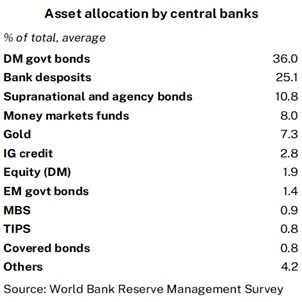
Liquidity
Central banks should be looking at reserves with a long-term lens, but they cannot escape short term liquidity considerations. Dealing with terms of trade shocks and associated currency volatility requires having some dry (but liquid) powder. Managing capital inflows, shifts in foreign portfolio investor positioning, and swings in international interest rates also can require occasional use of reserves, underscoring the need for liquidity.
But concerns around safety have begun to get intertwined with liquidity. If a bond market long considered safe begins to have issues around liquidity, would it still be in the safe category? Events like ratings downgrade, rate increase cycle, policy dysfunction in dealing with debt and deficit, financial repression measures, and political unrest could cause some liquidity to evaporate and spreads to widen. Most of these developments, especially in the realm of policy and political dysfunction, were long considered hallmarks of emerging market economies, with investors demanding a risk premium. Should they begin to do the same for developed market sovereign issuance as well?
Returns
Central banks can avoid mark-to-market risks by holding bonds to maturity. But that capacity does not negate the risk of losing out on real returns due to inflation and currency volatility. Perhaps the currency aspect can be managed through hedging, affecting returns nonetheless, but loss associated with inflation will remain unaddressed.
Is the mandate for the central bank to protect the real purchasing power of reserves or should they target a return threshold like sovereign wealth funds? Should they buy inflation protected bonds? What about increasing allocation to gold? Are there uncorrelated currency pairs available that can reduce excessive exposure to one currency?
If the currency in question is USD, then the data show that not many DM currencies can offer a quantitatively durable hedge to the greenback’s fluctuation. This is largely since most developed market economies face similar and synchronised shocks. In the past year, Chinese currency and China’s government bonds have been the ones offering low correlation and good return. Moving to British, European, or Japanese bonds would have brought in no gains in portfolio value.
From stablecoins to cryptos, gold to large company credit, EM equities and currencies, central banks are looking at a wider array of assets than they have done in the past. They are not going to ditch the dollar or load up on gold, but they are quite likely to buy less of the former and more of the latter. Central banks are inherently cautious and slow to move on their portfolio allocation. But their direction of travel toward more diversified holdings is clear.
Click here to read the full report.

Topic
GENERAL DISCLOSURE/ DISCLAIMER (For Macroeconomics, Currencies, Interest Rates, Digital Assets or Commodities)[1]
The information herein is published by DBS Bank Ltd and/or DBS Bank (Hong Kong) Limited (each and/or collectively, the “Company”). It is based on information obtained from sources believed to be reliable, but the Company does not make any representation or warranty, express or implied, as to its accuracy, completeness, timeliness or correctness for any particular purpose. Opinions expressed are subject to change without notice. This research is prepared for general circulation. Any recommendation contained herein does not have regard to the specific investment objectives, financial situation and the particular needs of any specific addressee. The information herein is published for the information of addressees only and is not to be taken in substitution for the exercise of judgement by addressees, who should obtain separate legal or financial advice. The Company, or any of its related companies or any individuals connected with the group accepts no liability for any direct, special, indirect, consequential, incidental damages or any other loss or damages of any kind arising from any use of the information herein (including any error, omission or misstatement herein, negligent or otherwise) or further communication thereof, even if the Company or any other person has been advised of the possibility thereof. The information herein is not to be construed as an offer or a solicitation of an offer to buy or sell any securities, futures, options or other financial instruments or to provide any investment advice or services. The Company and its associates, their directors, officers and/or employees may have positions or other interests in, and may effect transactions in securities mentioned herein and may also perform or seek to perform broking, investment banking and other banking or financial services for these companies. The information herein is not directed to, or intended for distribution to or use by, any person or entity that is a citizen or resident of or located in any locality, state, country, or other jurisdiction (including but not limited to citizens or residents of the United States of America) where such distribution, publication, availability or use would be contrary to law or regulation. The information is not an offer to sell or the solicitation of an offer to buy any security in any jurisdiction (including but not limited to the United States of America) where such an offer or solicitation would be contrary to law or regulation.
[#for Distribution in Singapore] This report is distributed in Singapore by DBS Bank Ltd (Company Regn. No. 196800306E) which is Exempt Financial Advisers as defined in the Financial Advisers Act and regulated by the Monetary Authority of Singapore. DBS Bank Ltd may distribute reports produced by its respective foreign entities, affiliates or other foreign research houses pursuant to an arrangement under Regulation 32C of the Financial Advisers Regulations. Where the report is distributed in Singapore to a person who is not an Accredited Investor, Expert Investor or an Institutional Investor, DBS Bank Ltd accepts legal responsibility for the contents of the report to such persons only to the extent required by law. Singapore recipients should contact DBS Bank Ltd at 65-6878-8888 for matters arising from, or in connection with the report.
DBS Bank Ltd., 12 Marina Boulevard, Marina Bay Financial Centre Tower 3, Singapore 018982. Tel: 65-6878-8888. Company Registration No. 196800306E.
DBS Bank Ltd., Hong Kong Branch, a company incorporated in Singapore with limited liability. 18th Floor, The Center, 99 Queen’s Road Central, Central, Hong Kong SAR.
DBS Bank (Hong Kong) Limited, a company incorporated in Hong Kong with limited liability. 11th Floor, The Center, 99 Queen’s Road Central, Central, Hong Kong SAR.
[1] This disclaimer may not apply if the applicable assets fall within the definition of 'financial instruments' that are set out in Article 2(1) EU MAR (e.g. financial instruments that are traded on a regulated market, MTF or OTF, etc.). Section C of Annex I of MiFID2 specifies these 'financial instruments'.
Related Insights
Related Insights
DISCLAIMER